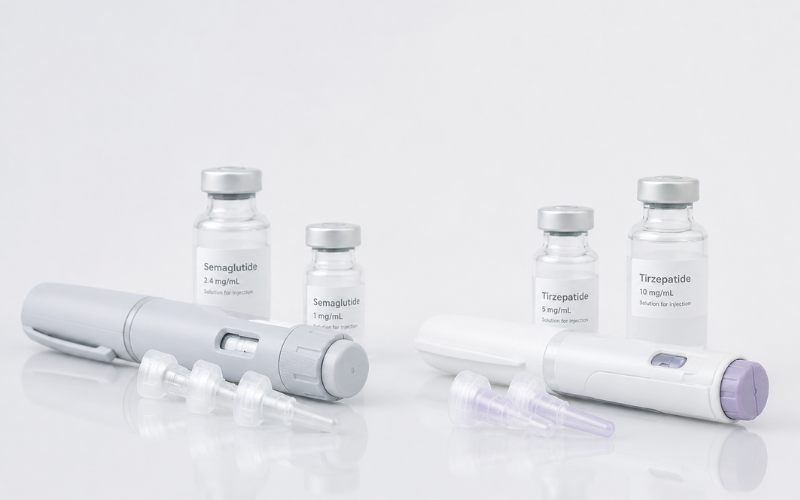
Both medications are GLP-1 receptor agonists. Both suppress appetite, slow gastric emptying, and have produced meaningful weight loss in large clinical trials. Both are now widely prescribed for weight management under brand names most people recognize: Ozempic and Wegovy for semaglutide, Mounjaro and Zepbound for tirzepatide.
So why does the choice between them matter? Because they are not the same medication. They work through related but different mechanisms, they have different efficacy profiles in the data, and they behave differently in different people. If you're deciding between them or wondering why your provider recommended one over the other, here's what the actual differences are.
The mechanism: one receptor vs. two
Semaglutide works on a single receptor: GLP-1 (glucagon-like peptide-1). This receptor is involved in insulin release, appetite regulation, and the rate at which your stomach empties after a meal. Activating it tells the brain you're full, slows digestion, and reduces how much you want to eat.
Tirzepatide activates two receptors: GLP-1 and GIP (glucose-dependent insulinotropic polypeptide). GIP is a second incretin hormone with its own effects on appetite and metabolism. When both receptors are activated simultaneously, the appetite-suppressing and metabolic effects appear to be additive in ways that single-receptor activation doesn't fully replicate.
This is why tirzepatide is sometimes described as a "dual agonist." It's not simply a stronger version of semaglutide. It works through a genuinely broader mechanism.
What the clinical trials actually show
The SURMOUNT-1 trial tested tirzepatide in adults with obesity or overweight plus at least one weight-related condition. At the highest dose (15 mg weekly), participants lost an average of 22.5 percent of their body weight over 72 weeks. At the lowest dose studied (5 mg), average weight loss was around 15 percent.
The STEP 1 trial for semaglutide at 2.4 mg weekly showed average weight loss of 14.9 percent over 68 weeks.
These aren't identical trial designs, so direct comparison has limits. But the pattern across both sets of data, and in real-world prescribing experience, is consistent: tirzepatide tends to produce greater average weight loss. For some patients, the difference is significant. For others, the gap is smaller.
Neither medication works the same way in everyone. Some people respond well to semaglutide and lose 15 to 20 percent of body weight. Others plateau early. The same variability exists with tirzepatide. The averages reflect trends, not guarantees for any individual.
Side effects: similar but not identical
Both medications share a common side effect profile, primarily gastrointestinal. Nausea, constipation, diarrhea, bloating, and reduced appetite are reported with both. These tend to be dose-dependent, most common during the titration phase, and manageable for most people with the right strategies.
Tirzepatide's GIP activity appears to reduce nausea compared to GLP-1 activation alone, which is part of why some patients find it more tolerable than semaglutide at equivalent doses. This isn't universal, but it's a pattern that shows up in both trial data and clinical experience.
The risk of more serious side effects, including pancreatitis and gallbladder disease, exists with both medications and is shared across the class. Anyone with a personal or family history of medullary thyroid carcinoma or multiple endocrine neoplasia should not use either drug.
Cost and access
This is often the deciding factor in practice. Semaglutide has been on the market longer, and compounded versions have been more widely available during shortages. Tirzepatide is newer, and while compounded tirzepatide became available as the brand-name version faced supply constraints, its availability and pricing have varied more.
Brand-name versions of both medications run $900 to $1,300 per month without insurance. Compounded versions, when available from licensed pharmacies, are typically a fraction of that. Coverage through insurance depends entirely on your specific plan and diagnosis codes, and prior authorization requirements vary significantly.
If cost is a barrier, your provider can help identify which option is more accessible for your situation.
Who tends to do better on each
There is no definitive test to predict who will respond better to which medication. Providers generally consider several factors when making a recommendation.
Patients with type 2 diabetes may have practical reasons to start with semaglutide, since it has longer-established FDA approval and dosing data for that indication. Patients who haven't responded well to other GLP-1 medications, or who have a significant amount of weight to lose and want the strongest average efficacy available, are often good candidates for tirzepatide.
Some patients switch between the two after trying one first. If you've been on semaglutide for several months at a stable dose and haven't reached a weight you find sustainable, tirzepatide is a reasonable next step to discuss with your provider.
The short answer
Semaglutide and tirzepatide are both effective medications. Tirzepatide tends to produce greater average weight loss in the data. Semaglutide has a longer track record and is often more straightforward to access or afford. Neither is categorically better for every patient.
The right choice depends on your medical history, how you've responded to other treatments, and practical factors like cost and availability. Your provider can help you weigh those specifics against the clinical picture.
Pomegranate offers physician-guided programs for both semaglutide and tirzepatide. If you have questions about which medication is right for your goals, your care team is available to help.