Wait, My Period Did What?
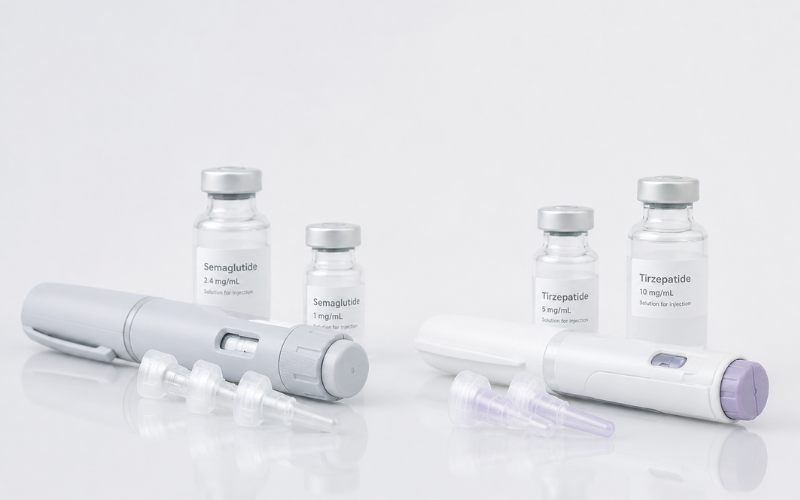
If you started a GLP-1 medication like semaglutide or tirzepatide and your cycle suddenly decided to go rogue, you are absolutely not imagining it, and you are definitely not alone. Shorter cycles, longer cycles, spotting between periods, cramps that feel unfamiliar, a period that shows up two weeks early like an uninvited guest. It's a lot, and most of the information out there focuses on nausea and weight loss numbers, not what's happening to your cycle. Let's fix that.
Why Weight Loss Itself Shakes Things Up
Your menstrual cycle is sensitive to change, and rapid weight loss is exactly the kind of change it notices. Fat tissue produces estrogen, so when you lose a meaningful amount of body fat relatively quickly, your estrogen levels can shift. That shift alone can be enough to throw your cycle's usual rhythm off for a few months while your body recalibrates.
There's also a metabolic angle. For women with PCOS or insulin resistance, weight loss can actually improve hormonal balance and make cycles more regular than they were before starting treatment. So depending on where you started, GLP-1s might make your cycle messier or, ironically, more predictable. Bodies are annoyingly individual that way.
The Surprise Fertility Conversation
Here's something that catches a lot of women off guard: improved insulin sensitivity and weight loss can restore ovulation in women who weren't ovulating regularly before, particularly those with PCOS. Which means pregnancy becomes more possible, sometimes unexpectedly so. If pregnancy isn't part of the plan right now, this is genuinely worth a conversation with your provider about contraception, because "I didn't think I could get pregnant" has surprised more than a few people on these medications.
On the flip side, GLP-1 medications are not recommended during pregnancy, and most guidance suggests stopping them for a period of time before trying to conceive. If pregnancy is something you're planning for, timing matters, and it's a conversation to have early rather than after the fact.
Cramps, Spotting, and the Stuff Nobody Warns You About
Some women report heavier or more painful cramping in the first few cycles after starting treatment. Others get lighter periods entirely, or skip a cycle altogether, especially if weight loss has been fast. Breakthrough spotting between periods shows up occasionally too, and while it's usually not dangerous, it's disruptive and honestly kind of annoying when you're not expecting it.
None of this is universal. Some women notice zero cycle changes at all and wonder what everyone else is talking about. Bodies respond differently, and that's frustrating when you're trying to find a pattern that applies to you specifically.
When This Is Just Adjustment, and When It's Not
A cycle that's irregular for two or three months after starting a GLP-1 is generally considered part of the adjustment period, especially alongside rapid weight change. Your body is recalibrating hormone production, and that takes time to settle.
That said, certain things are worth a call to your doctor rather than a shrug. Bleeding that's unusually heavy, periods that stop for several months with a negative pregnancy test, severe pelvic pain, or spotting that's persistent rather than occasional. These aren't necessarily emergencies, but they're not things to just wait out either. Your provider can check thyroid function, hormone levels, and rule out anything unrelated to the medication itself.
What You Can Actually Do About It
Track your cycle. Not just the start date, but symptoms, flow, and how you're feeling. Apps make this easy, but even a notes app works fine. This gives you and your provider actual data instead of vague memory when something feels off.
Stay ahead of nutrition, particularly iron and protein, since heavier or more frequent cycles combined with reduced appetite from the medication can quietly lead to deficiencies. It's an easy thing to overlook when you're focused on the number on the scale.
And give it time before assuming something is wrong. Three to four cycles is a reasonable window to expect some irregularity while your body adjusts to both the medication and the weight change happening alongside it.
The Bottom Line
Your cycle isn't background noise in this process, it's actually a pretty good indicator of what's happening hormonally as your body changes. Some disruption in the first few months is normal and usually temporary. Significant, persistent changes deserve a real conversation with your provider, not a Google search at 1am and a spiral of worst case scenarios.
GLP-1 medications weren't designed with menstrual cycles as the primary focus, but for women, that connection is real and worth paying attention to, even if it doesn't make it into most of the marketing materials.